

(Last updated: April 2026)
The da Vinci Bridge is one of the most remarkable engineering concepts to emerge from the Renaissance — a structure so cleverly designed that it holds itself together without a single nail, rope, or fastener. Conceived by Leonardo da Vinci around 1502, this portable bridge challenged everything people thought they knew about construction and military logistics.
What makes it truly fascinating is its simplicity. Leonardo didn't rely on complex materials or advanced tools. He used pure geometry. The logs interlock under their own weight, each pressing against the others to create stability rather than collapse. The more weight placed on the bridge, the stronger it becomes.
Historically, this idea arrived at a pivotal moment. Europe's armies were crossing rivers, building supply lines, and conquering new territories. A bridge that could be assembled and disassembled in minutes — with no hardware — was not just clever. It was revolutionary. Leonardo designed it for Cesare Borgia, the ruthless military commander for whom he briefly served as an engineer.
Understanding the Leonardo da Vinci self-supporting bridge also transforms how you experience his legacy in museums and exhibitions today. When you stand in front of a reconstruction — whether in Milan, Florence, or a science museum elsewhere in Europe — you're not just looking at a model. You're seeing proof that one man, working in the late 15th century, was thinking about structural engineering in ways that engineers still admire today.
This post is all about the da Vinci bridge — its design, its history, how it works, and where you can see it brought to life in person.
What Is the Da Vinci Bridge?
The da Vinci bridge is a self-supporting, freestanding structure designed by Leonardo da Vinci around 1502. It uses interlocking logs or beams — with no fasteners of any kind — to create a stable, load-bearing bridge. Its design relies on compression and friction. Each beam supports the others, and the entire structure becomes stronger under load.
The Engineering Idea Behind the Da Vinci Bridge
Leonardo's Design Concept
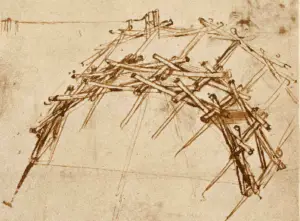
Leonardo sketched the bridge in Codex Atlanticus, his extraordinary collection of notes and drawings now housed at the Biblioteca Ambrosiana in Milan. The sketch is deceptively simple — a series of curved beams crossing over and under each other in a repeating pattern.
The genius lies in what's not there. No nails. No rope. No mortar. The beams themselves are the fasteners. Each one rests in a notch created by the others, held in place by gravity and lateral compression.
Leonardo envisioned this as a military tool. A portable structure that soldiers could assemble quickly to cross rivers during campaigns. It could also be disassembled and carried to the next crossing point. In an era when most bridges took weeks to build, this was an extraordinary tactical advantage.
Renaissance Engineering Principles
Leonardo was working during a period when engineers were beginning to move beyond inherited Roman techniques. He studied proportion, physics, and mechanics obsessively — filling thousands of pages with observations about how the natural world behaves under force and load.
His approach to the self-supporting da Vinci bridge reflects this broader method. Rather than asking "how do we fasten these beams together?", he asked, "How can the beams fasten themselves?" That shift in thinking — from addition to integration — is deeply characteristic of how Leonardo approached nearly every design problem.
Renaissance engineering principles emphasized harmony between form and function. A well-designed structure was expected to be both beautiful and efficient. The da Vinci bridge achieves both. Its interlocking geometry has an elegance that engineers and mathematicians still find compelling today.
Why the Idea Mattered
The da Vinci bridge design mattered for several reasons beyond its immediate military use.
| Principle | Explanation | Why It Matters |
|---|---|---|
| Structural Stability | Achieved entirely through geometric interlocking, without nails or fasteners | Influenced modern architecture, engineering, and material design principles |
| Portability | Designed to be quickly assembled, disassembled, and transported | Crucial for military logistics, where mobility determined strategic advantage |
| Scalability | Works at any size, from small models to full-scale timber structures | Demonstrates universal physics principles still used in education today |
Leonardo da Vinci self-supporting bridge is an engineering marvel from the Renaissance.
It stands purely through balance and clever design. This bridge captures Leonardo’s ability to merge art, science, and functionality in a single masterpiece.
How the Da Vinci Bridge Works
Mechanical Design
The structure consists of two types of elements: support beams that run lengthwise, and cross-members that lock them in place. The cross-members are notched or curved so they nestle into the gaps between support beams. When assembled correctly, each beam is trapped in position by the others.
The overall shape is slightly arched when viewed from the side. This arch is not decorative — it's structural. The curve distributes compressive forces outward toward the banks of the river, following the same principle used in Roman arches.
If you're following da Vinci bridge step-by-step instructions, you'll typically begin by laying the central cross-members, then weave the outer beams over and under them in a specific sequence. The exact order matters. Assembled incorrectly, the structure falls apart. Assembled correctly, it holds firm even under significant weight.
Structural Principles
The Leonardo da Vinci self-supporting bridge works because of two physical forces: compression and friction.
Compression occurs when the beams press against each other. Each beam is wedged between two others, creating a squeeze that locks it in place. The harder you push down on the bridge, the more the beams squeeze together, and the stronger the structure becomes.
Friction prevents the beams from sliding apart under lateral force. The contact points between beams are large enough that friction — the resistance between two surfaces pressing together — holds everything in alignment.
These are the same forces at work in a stone arch or a barrel vault. Leonardo understood this intuitively, and his da Vinci bridge calculations (though never published in his lifetime) reflect a sophisticated grasp of structural mechanics.
Why the Idea Still Matters
Modern engineers and educators find the Leonardo bridge design remarkable precisely because it has no single point of failure. Remove one beam, and the others may shift — but the structure often holds. Adding weight to the center increases compression at every joint, making the bridge more stable, not less.
This counterintuitive behavior — where more load means more strength — is the hallmark of a well-designed compressive structure. It's the same reason Roman aqueducts have survived for two thousand years.
The da Vinci bridge is now a popular teaching model in physics and engineering classrooms worldwide. Students build da Vinci bridge models from popsicle sticks or craft sticks to explore structural principles firsthand. The bridge has appeared in science fairs, university engineering programs, and even professional architectural workshops.
Is the da Vinci bridge strong? When built correctly, yes — remarkably so. Some full-scale reconstructions have supported the weight of multiple adults walking across simultaneously.
How to Build A Leonardo Da Vinci Bridge with Popsicle Sticks (DIY Guide)
Fun, Educational, and Hands-On
Building a Da Vinci bridge at home or in the classroom is fun and educational. You can use popsicle sticks, pencils, or even wooden dowels.
Materials you'll need:
- Popsicle sticks (about 20–30 or more, depending on your desired length)
- A flat surface (like a desk or table)
- Patience and a curious spirit!
Da Vinci Bridge Instructions (step-by-step guide)
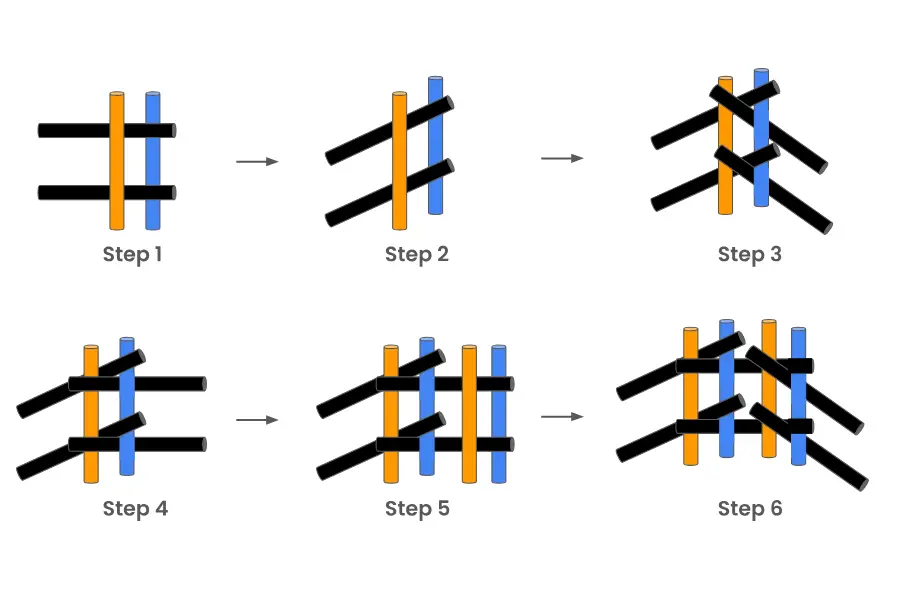
Step 1: Arrange your base sticks. Place four popsicle sticks on a flat surface, parallel to each other and evenly spaced. In your guide, these are shown with the orange side up and the blue side down to help visualize orientation.
Step 2: Lift the base. Gently lift the parallel sticks slightly off the surface. This begins creating the arch shape and allows weaving to start smoothly.
Step 3: Insert two cross sticks. From the right side, weave two black popsicle sticks through the lifted structure. These sticks secure the base together and form the first layer of crossing.
Step 4: Lift again. Carefully lift the structure higher to create space and tension for the next set of sticks. This helps stabilize the early framework.
Step 5: Add two more parallel sticks. Place two additional popsicle sticks on top, parallel to the original base sticks, with the same orange side up and blue side down. This starts creating the layered arch.
Step 6: Weave in two more cross sticks. From the right side again, insert two more black sticks, weaving them through the new parallel sticks. By this point, the structure should start to hold itself — this is the self-supporting stage.
Repeat and extend. Repeat Steps 5 and 6 as many times as you'd like to extend the bridge. Each additional layer makes it longer and stronger.
Test and fine-tune. Once your bridge stands on its own, carefully test it by placing small objects on top. Watch how the forces distribute and adjust if needed. Try different lengths or angles to explore how the design changes.
Tips:
- Use smooth, sturdy sticks for better stability and easier weaving.
- Move slowly and gently when lifting or weaving to avoid collapse.
- Challenge yourself by using pencils, chopsticks, or dowels for a different style!
Download our free step-by-step illustrated PDF guide to build your own Da Vinci bridge at home or in class!
Where to See the Da Vinci Bridge Today
Museums and Exhibitions
The most direct way to encounter the da Vinci bridge in real life is through the science and technology museums that hold reconstructions based on Leonardo's original sketches.
The Museo Nazionale della Scienza e della Tecnologia Leonardo da Vinci in Milan is the definitive destination. It holds the world's largest collection of wooden models based on Leonardo's designs, many of which were constructed directly from the Codex Atlanticus. The bridge model is displayed alongside dozens of other machines — flying devices, hydraulic systems, military equipment — in a way that allows visitors to understand Leonardo's engineering thinking as a whole.
The museum is housed in a 16th-century monastery in Milan's Sant'Ambrogio district, which adds a genuinely Renaissance atmosphere to the visit. Wandering through the long wooden galleries, surrounded by reconstructed machines, is unlike any other museum experience in Italy.
In Florence, the Museo Galileo and the broader network of science-focused cultural spaces also explore Renaissance engineering, though the Milan museum remains the gold standard for Leonardo's mechanical designs.
Modern Reconstructions
One of the most celebrated real-world tests of Leonardo da Vinci's self-supporting bridge took place in 2019, when researchers at MIT conducted a detailed structural analysis and built a full-scale replica. Their findings confirmed that the design would have worked exactly as Leonardo intended — stable, load-bearing, and deployable without tools.
In Norway, a permanent bridge inspired by Leonardo's original golden horn bridge concept (a proposal he made to Sultan Bayezid II of the Ottoman Empire in 1502) was built near Oslo in 2001. The Leonardo Bridge in Ås, designed by artist Vebjørn Sand, spans a pedestrian path and demonstrates how a 500-year-old concept can translate into a fully functional modern structure.
Leonardo had originally proposed this bridge as a span across the Golden Horn inlet in Istanbul — one of the longest bridges of the ancient world, had it been built. The Ottoman sultan declined, and the design remained on paper for five centuries.
Visitor Experience and City Context
Visiting Milan to see da Vinci bridge models and related engineering exhibits fits naturally into a broader Leonardo itinerary. The city holds the most concentrated collection of Leonardo's work anywhere in the world — including The Last Supper fresco at Santa Maria delle Grazie, which requires advance booking, and the Codex Atlanticus itself at the Biblioteca Ambrosiana.
A visit to the science museum typically takes two to three hours. The Leonardo collection alone is extensive, but the wider museum — which covers Italian scientific history from the Renaissance to the Space Age — rewards a longer visit.
Milan is also an excellent base for day trips to other Leonardo-connected sites in Lombardy, including Vigevano (where Leonardo designed urban improvements for Ludovico Sforza) and the Navigli canal district, where Leonardo contributed to hydraulic engineering.
Many visitors choose an entrance-only ticket for flexibility, while others prefer a guided tour for deeper historical context. If you're traveling with a particular interest in Leonardo's engineering work, a specialist-guided visit can make the connections between his drawings and the physical models far more vivid.
Exploring Leonardo da Vinci in Milan
Milan is the city most deeply connected to Leonardo's working life. He spent nearly twenty years here under the patronage of Ludovico Sforza, producing some of his greatest paintings, engineering projects, and scientific notebooks. The da Vinci bridge concept, the canal systems, the equestrian monument, and The Last Supper all belong to this Milanese period.
Walking through Milan with Leonardo in mind is a genuinely different experience from a standard city tour. The science museum, the refectory at Santa Maria delle Grazie, the Ambrosiana library, and the Castello Sforzesco each hold a different piece of his legacy — and together they sketch the full portrait of a mind that could move between painting, architecture, hydraulics, and military engineering without ever losing its curiosity.
For further reading on Leonardo's world, explore our guides to:
- Leonardo da Vinci in Milan — the full cultural itinerary
- Leonardo da Vinci in Florence — his formative years and early masterworks
- Leonardo Museums in Italy — a complete guide to collections across the country
- Leonardo da Vinci in France — his final years at Château du Clos Lucé
- Renaissance Engineering Inventions — the machines that changed history
Final Thoughts
This post is all about the da Vinci bridge — a structure that continues to amaze engineers, educators, and cultural travelers five centuries after Leonardo sketched it in a notebook. What makes it endure isn't just its cleverness. It's the proof it offers that genuine creative thinking can solve problems in ways that conventional thinking never would.
Leonardo didn't invent the arch, the beam, or friction. But he combined them in a way that had never been done before — producing something portable, elegant, and powerful. That combination is the essence of Renaissance innovation. It's also why his notebooks feel so startlingly modern when you read them today.
If you ever have the chance to stand in front of a full-scale reconstruction — or even to build a small model yourself from popsicle sticks — take it. There's a moment, when the last beam locks into place and the whole structure suddenly becomes rigid and stable, when you understand exactly what Leonardo understood. It's not just engineering. It's an idea about how things can support one another.
FAQs about the da Vinci Bridge
The da Vinci bridge works through a system of interlocking wooden beams that hold each other in place using compression, gravity, and friction. As weight is applied, the beams press together more tightly, creating a stable, self-supporting structure without nails or ropes.
Leonardo da Vinci designed his self-supporting bridge while working as a military engineer, likely under Cesare Borgia. The bridge was intended to be quickly assembled and dismantled, allowing armies to cross rivers efficiently and remove the structure to prevent pursuit.
Yes, the da Vinci bridge is surprisingly strong because its design distributes weight evenly across all beams. In fact, the structure often becomes more stable as additional weight is applied, since the forces increase the locking effect between the pieces.
The exact weight a da Vinci bridge can hold depends on its size and materials, but experiments and models show it can support significant loads relative to its scale. Even simple classroom models can hold heavy objects, while engineered versions have demonstrated the ability to support structural loads effectively.
The bridge relies on key physics principles such as compression, tension, and friction. Each beam transfers force to the next, creating a chain of balanced forces that stabilize the structure. The geometry ensures that loads are distributed evenly, preventing collapse.
The main principles behind the da Vinci bridge are self-supporting geometry, interlocking design, and load distribution. The beams form a “self-locking” system where each piece depends on the others, allowing the bridge to stand without fasteners while remaining portable and scalable.
Related Post You May Like



Disclosure: This page may contain affiliate links. If you choose an experience through them, it helps support the site at no extra cost to you.
 Leonardo Bianchi is the founder of Leonardo da Vinci Inventions & Experiences, a cultural travel guide helping visitors explore Leonardo da Vinci’s art, inventions, and legacy across Italy and Paris.